
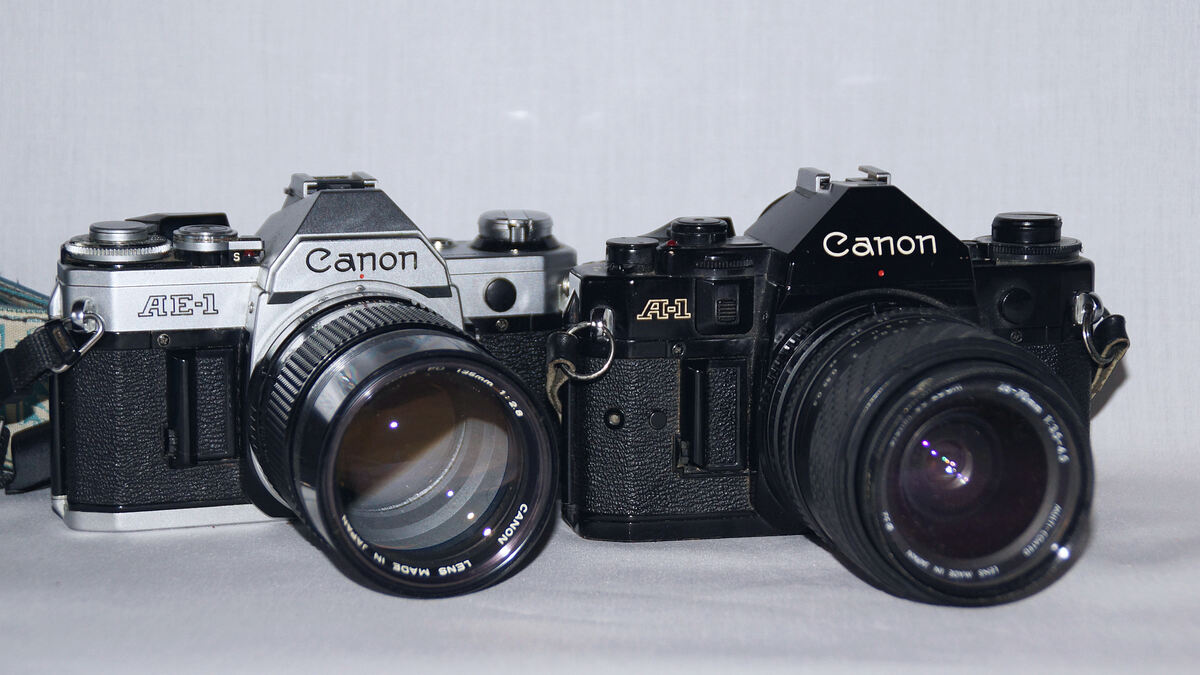
Before the digital revolution, before the swift, silent precision of the EOS system, there was an era of metal, glass, and mechanics. A time when photography was a tangible, deliberate craft. In the 1970s and early 1980s, the battle for the hearts and hands of photographers was fiercely waged, and Canon, a determined challenger, was about to unleash a series of cameras that would not only redefine the market but also democratize photography for millions. This is the story of that golden age, a dynasty built upon the legendary FD-mount and spearheaded by four iconic models: the F-1, the AE-1, the A-1, and the AE-1 Program.
The stage was set in a world dominated by Nikon. The Nikon F and its successor, the F2, were the undisputed kings of professional photography, their names synonymous with rugged reliability. Canon, while a respected manufacturer, was often seen as playing catch-up. Their transition from the older FL lens mount to the new, more capable FD mount in 1971 was the first salvo in a long campaign. The FD mount, with its breech-lock mechanism and ability to communicate aperture information to the camera body, was the foundation upon which an empire would be built.
The Professional's Choice: The Canon F-1 (1971)
Canon's first major statement in the professional SLR market was the F-1. Launched in 1971 after five years of development, this was not a camera for the casual hobbyist. The F-1 was a brute—a meticulously engineered, heavy-duty system camera designed to go head-to-head with the Nikon F2. It was a declaration of intent: Canon could build a camera tough enough for the harshest conditions, reliable enough for a warzone, and versatile enough for scientific application.
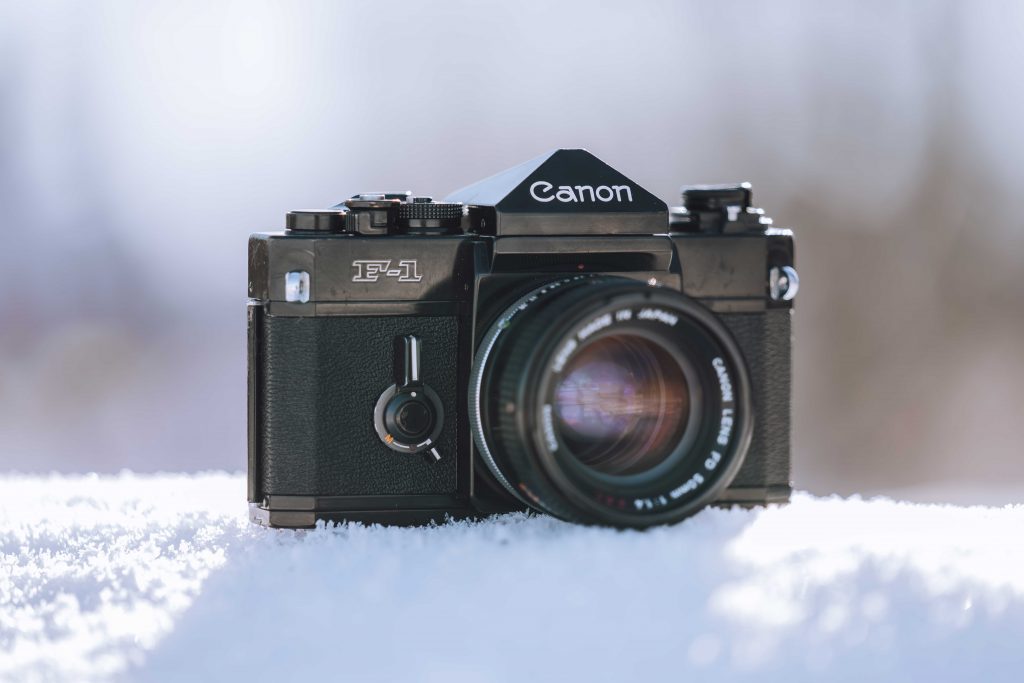
Its key feature was its profound modularity. The F-1 wasn't just a body; it was the core of a sprawling ecosystem. You could swap out the standard eye-level pentaprism for a waist-level finder, a speed finder, or a servo-automated finder. There were multiple focusing screens, massive 250-exposure film backs, and powerful motor drives. This was a camera that could be tailored to any conceivable professional task, from macro photography to high-speed sports coverage.
Unlike the electronically controlled cameras that would follow, the F-1 was a mechanical masterpiece. Even with a dead battery, its shutter, ranging from 1 second to a swift 1/2000s, would still fire flawlessly. The battery was only needed for the built-in light meter. This mechanical dependability was a non-negotiable feature for professionals who couldn't afford a failure on assignment. Holding one today, you feel the density of its brass construction, the confident, mechanical click of the shutter dial, and the heft that screams "tool, not toy." The F-1 established Canon's credentials at the highest level, proving they could build for the best.
The Revolution for the Masses: The Canon AE-1 (1976)
If the F-1 was a targeted strike at the professional elite, the Canon AE-1 was a full-scale invasion of the consumer market. Launched in 1976, it was a landmark camera, arguably the most important SLR of its decade. Its innovation wasn't purely mechanical might, but electronic intelligence. The AE-1 was the world's first camera to be controlled by a central processing unit (CPU).
"So advanced, it's simple." – Canon's marketing slogan for the AE-1
This microprocessor-driven design had two profound effects. First, it drastically reduced the number of moving parts compared to its mechanical predecessors, which in turn lowered manufacturing costs. Second, it enabled a feature that would change everything: Shutter-Priority AE (Automatic Exposure). For the first time, a beginner could simply select a shutter speed to freeze action or create motion blur, and the camera's "brain" would automatically select the correct aperture for a perfect exposure. As canonclassics.com points out, the camera offered this shutter-priority AE or a match-needle system for manual metering, giving users creative control when they wanted it.
Canon backed this technological leap with an unprecedented, aggressive marketing campaign. They targeted not just photography magazines, but mainstream television and print media, featuring celebrity endorsements from sports stars and actors. The message was clear: you no longer needed to be a technical expert to take great pictures. The strategy worked beyond their wildest dreams. Between 1976 and 1985, Canon sold over 30% of all consumer SLRs from the major Japanese brands, a meteoric rise led by the AE-1 [678vintagecameras.ca]. In total, a staggering 5.7 million units were produced.
The AE-1 was not a professional camera like the F-1; its body used more plastic to keep weight and cost down, and it lacked the robust sealing and modularity of its bigger brother [canonclassics.com]. But for millions of families, students, and aspiring artists, it was the gateway to serious photography. The iconic "shutter squeak" that many old AE-1s develop is a quirky testament to their age, but the satisfying *thwack* of its mirror and shutter remains a defining sound of 35mm photography.
The Technophile's Dream: The Canon A-1 (1978)
Two years after the AE-1 democratized the SLR, Canon unleashed a technological tour de force: the A-1. If the AE-1 was about making things simple, the A-1 was about giving the enthusiast every conceivable option. It was Canon's top-of-the-line A-series camera and a true gadget-lover's delight [casualphotophile.com].
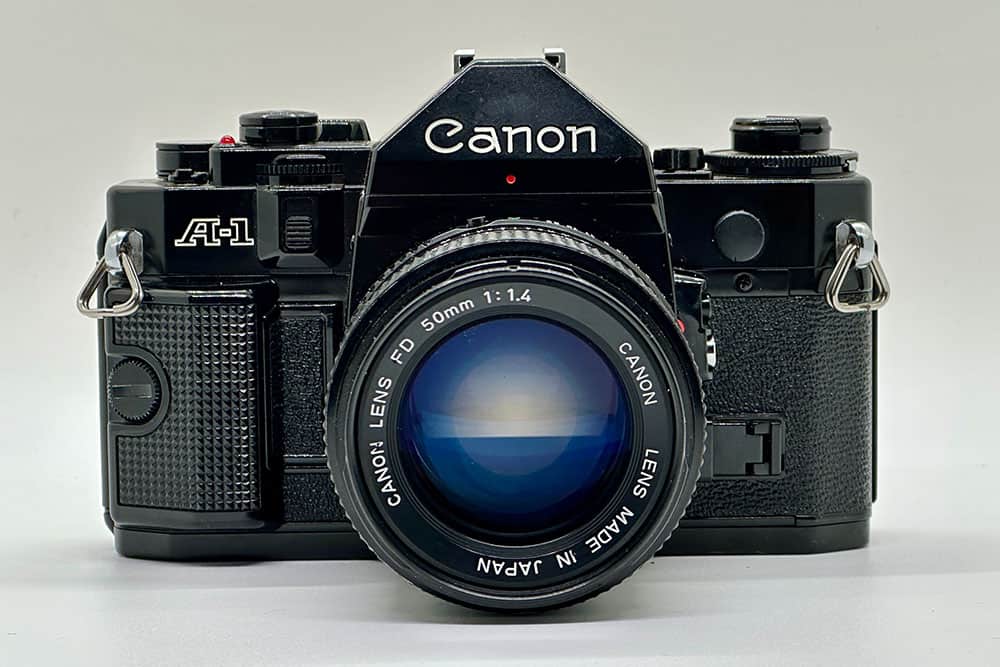
The A-1's headline feature was groundbreaking: it was the first SLR to offer all five of the now-standard exposure modes. A small dial let the user select:
- Shutter-Priority AE: You set the shutter speed, the camera sets the aperture.
- Aperture-Priority AE: You set the aperture, the camera sets the shutter speed.
- Program AE: The camera's CPU sets *both* the shutter speed and aperture based on a pre-determined program. This was the ultimate "point-and-shoot" mode for an SLR.
- Stopped-Down AE: For use with older lenses or accessories like bellows.
- Full Manual: You control everything.
Instead of the AE-1's analog needle, the A-1 featured a futuristic red digital LED display in the viewfinder to show exposure settings. It felt like a camera from the future. The A-1 was aimed squarely at the advanced amateur who understood exposure theory and craved creative control, but also appreciated the convenience of automation. Its build quality was also a step up from the AE-1, with a more robust feel [analog.cafe].
Interestingly, despite being technically superior, the A-1 was never as commercially successful as its simpler sibling. As one columnist at casualphotophile.com notes, even today in the used market, AE-1s outsell A-1s by a factor of ten to one. The AE-1's simplicity and lower price point had captured the mass market's imagination, while the A-1's complexity, though powerful, appealed to a more niche, tech-savvy audience. Nevertheless, it cemented Canon's reputation as an innovator and previewed the multi-mode functionality that would become standard on all future cameras.
The Refined Successor: The Canon AE-1 Program (1981)
By 1981, Canon had a winning formula. The AE-1 was a sales behemoth, and the A-1 had introduced groundbreaking technology. The logical next step was to combine the best of both worlds. The result was the Canon AE-1 Program.
The AE-1 Program took the wildly popular and familiar body of the AE-1 and infused it with the "full auto" Program AE mode from the A-1. This was the masterstroke. It offered the easy-to-understand shutter-priority mode of the original, but added a "P" on the dial for true set-it-and-forget-it shooting. It was the ultimate bridge camera, offering a clear upgrade path for existing AE-1 owners and an even more appealing entry point for newcomers.
Outwardly, it was almost identical to the AE-1, but with the addition of a more pronounced grip on the right side and a new interchangeable focusing screen system. The AE-1 Program was an instant hit, so much so that it was sold alongside the original AE-1 for several years due to the continued popularity of both models [678vintagecameras.ca]. It represented the pinnacle of the A-series philosophy: powerful, automated features packed into an affordable, lightweight, and user-friendly body. It was the last great manual-focus SLR for the masses before the industry pivoted towards the next big thing: autofocus.
A Quick Timeline of an Era
- 1971: Canon launches the professional F-1 system and the FD mount.
- 1976: The revolutionary, CPU-controlled Canon AE-1 is introduced, bringing Shutter-Priority AE to the masses.
- 1978: The technologically advanced Canon A-1 debuts as the first SLR with five exposure modes, including Program AE.
- 1981: The Canon AE-1 Program is released, blending the AE-1's popularity with the A-1's Program mode.
- 1987: Canon launches the EOS (Electro-Optical System) with the EF mount and autofocus cameras, marking the end of the FD era.
Shared DNA: The FD Mount and A-Series Ergonomics
The common thread linking these consumer classics was the Canon FD lens mount. This system, designed for mechanically controlled lenses, was key to their success [analog.cafe]. Canon produced a huge range of high-quality and affordable FD lenses, from ultra-wide angles to massive telephotos. Their "S.S.C." (Super Spectra Coating) lenses were particularly renowned for their excellent color rendition and flare resistance. This vast and accessible lens system meant that a photographer could start with an AE-1 and a 50mm f/1.8 kit lens and gradually build a versatile system without breaking the bank.
The A-series cameras also shared a distinct design language. They were compact and relatively lightweight for their time, with intuitive ergonomics. The controls were logically placed, the film advance lever had a short, smooth throw, and the viewfinders were large and bright. They were designed not to be intimidating, but inviting. This focus on user experience was a massive part of their appeal and a core reason why they brought so many new people into the world of SLR photography.
The Legacy: Paving the Road to EOS
The immense financial success and market dominance achieved by the A-series cannot be overstated. By creating a massive, loyal customer base and generating huge profits, cameras like the AE-1 and AE-1 Program provided Canon with the resources and the mandate to invest heavily in research and development for the next photographic revolution.
When the autofocus era dawned, Canon made a bold and controversial decision: to abandon the beloved FD mount entirely and create the all-new, fully electronic EF mount for its EOS system. This broke compatibility with all previous lenses, a move that alienated some longtime users. However, the financial security and market leadership built on the backs of the AE-1 and its brethren gave Canon the confidence to make this risky bet. It paid off spectacularly, and the EOS system would go on to dominate the professional and consumer markets for decades to come. The titans of the FD era had laid the commercial and technological groundwork for Canon's future reign.
These Titans Today: Enduring Relevance in a Digital World
Decades after they were discontinued, what is the place of these cameras? For a growing number of photographers, they represent an authentic and rewarding way to create images. There is an undeniable joy in the tactile process: advancing the film, feeling the click of the aperture ring, and hearing the mechanical finality of the shutter. For collectors, they are icons of industrial design and milestones in photographic history, with prices that reflect their enduring popularity.
Most practically, the incredible collection of Canon FD lenses has found a second life. Thanks to simple, inexpensive adapters, these classic prime and zoom lenses can be mounted on today's mirrorless digital cameras from Sony, Fujifilm, Olympus, and even Canon's own R-series. This allows a new generation to experience the unique character and superb optical quality of vintage S.S.C. glass, blending the best of the analog past with the convenience of the digital present.
In the end, the Canon F-1, AE-1, A-1, and AE-1 Program are more than just obsolete technology. They are cultural artifacts that embody a pivotal moment in photography. They are tools that empowered millions, cameras that built an empire, and timeless machines that, even today, offer a pure, unfiltered connection between the eye, the hand, and the final image.